

by: haseeb
-
July 23, 2026
-
Comments (0)
If you’ve ever Googled “how to get more customers online,” you’ve probably come across two answers that keep showing up: SEO and Paid Advertising. And if you’re a business owner trying to figure out where to put your marketing budget, the debate between the two can feel overwhelming.
The truth is, both work. But they work differently, at different speeds, for different goals — and choosing the wrong one (or ignoring one entirely) can mean wasted money and missed opportunities.
In this guide, we break down exactly what SEO and Paid Ads are, how they compare, and most importantly, which one is right for your business right now.
What Is SEO?
Search Engine Optimization (SEO) is the process of optimizing your website and content so that it ranks higher in organic (unpaid) search results on Google and other search engines.
When someone searches “digital marketing agency in Dubai” and clicks on a result that isn’t an ad, that’s SEO at work.
SEO covers several areas:
- On-Page SEO — optimizing your content, headings, meta tags, and keywords
- Technical SEO — improving site speed, mobile usability, crawlability, and Core Web Vitals
- Off-Page SEO — building backlinks and domain authority
- Local SEO — optimizing for location-based searches and Google Business Profile
- Content Marketing — creating blogs, guides, and pages that rank for target keywords
The key characteristic of SEO: you don’t pay for each click. Once you rank, traffic is essentially free.
What Are Paid Ads?
Paid Advertising (PPC — Pay Per Click) is exactly what it sounds like: you pay to appear at the top of search results, social media feeds, or other digital platforms.
The most common paid ad channels include:
- Google Ads — appear at the top of search results for specific keywords
- Meta Ads (Facebook & Instagram) — reach targeted audiences based on interests, demographics, and behavior
- LinkedIn Ads — ideal for B2B targeting based on job title, industry, and company size
- YouTube Ads — video advertising to reach engaged viewers
- Display & Programmatic Ads — banner ads across millions of websites
The key characteristic of Paid Ads: results are immediate, but you pay for every click. The moment you stop spending, the traffic stops.
The Case for SEO
1. It Builds Long-Term, Compounding Value
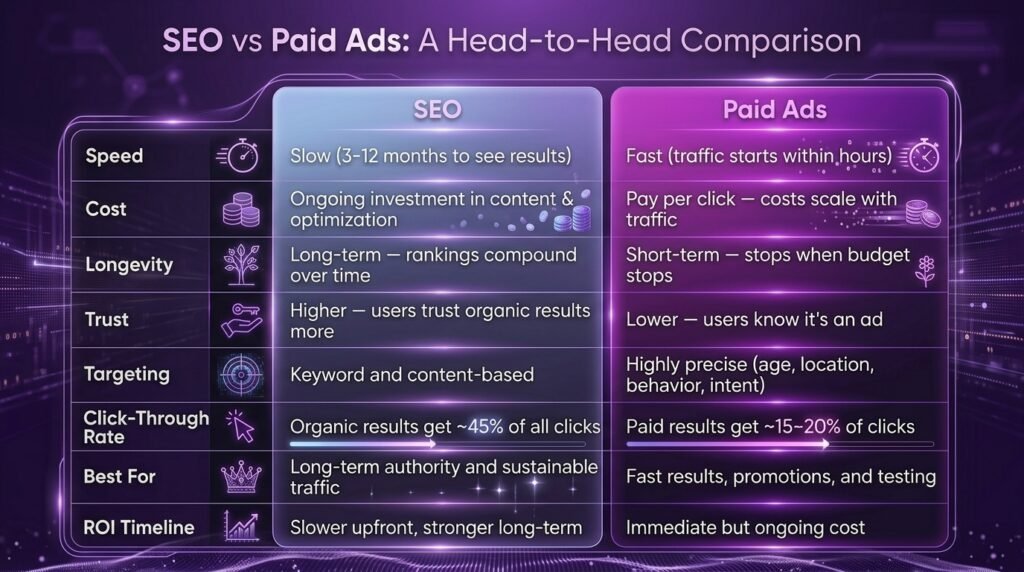
SEO is like planting a tree. It takes time to grow, but once it does, it keeps producing results without ongoing cost per click. A blog post that ranks on page one today can drive traffic for years.
2. Organic Traffic Converts Well
People who find you through organic search are actively looking for what you offer. This high-intent traffic tends to convert at strong rates because the user is already in research or buying mode.
3. It Builds Credibility and Trust
Studies consistently show that users trust organic results more than ads. Ranking on page one of Google signals authority and legitimacy — something paid ads can’t replicate in the same way.
4. The Cost Per Click Is Effectively Zero
Once you rank, every click is free. Compare that to Google Ads where competitive keywords can cost anywhere from $2 to $50+ per click. Over time, a strong SEO strategy dramatically reduces your cost of customer acquisition.
5. It Supports Every Other Marketing Channel
Good SEO means a faster website, better content, stronger user experience, and higher domain authority — all of which benefit your paid campaigns, social media, and email marketing too.
SEO is right for you if:
- You’re thinking long-term and want sustainable traffic
- You want to reduce reliance on ad spend over time
- You’re building a content-driven brand or authority site
- You have time to invest before seeing results
The Case for Paid Ads
1. Results Are Immediate
Unlike SEO, paid ads can drive traffic to your website within hours of launching a campaign. If you need leads or sales now, paid advertising is the fastest path to results.
2. Precision Targeting Is Unmatched
Paid platforms let you target by keyword intent, location, age, interests, behavior, job title, device, time of day, and more. You can put your offer in front of exactly the right person at exactly the right moment.
3. It’s Highly Scalable
Find an ad campaign that converts? Simply increase the budget and scale your results. Paid advertising gives you direct control over how aggressively you grow.
4. Perfect for Testing and Validation
Before investing in long-form content and SEO strategy around a topic, paid ads let you test whether a keyword, offer, or audience actually converts — in days, not months.
5. You Own the Top of the Page
For highly competitive keywords where ranking organically would take years, paid ads let you appear at the very top of Google immediately, putting you in front of high-intent searchers right now.
Paid Ads are right for you if:
- You need leads or sales quickly
- You’re launching a new product or promotion
- You’re in a highly competitive market
- You have a defined budget and want measurable, immediate ROI
3 Misconceptions You Need to Stop Believing
Misconception 1: “SEO is free” SEO isn’t free — it requires real investment in content creation, technical optimization, link building, and ongoing strategy. What it doesn’t require is paying for each individual click once you rank. Think of it as a one-time build with long-term returns, rather than an ongoing cost per visitor.
Misconception 2: “Paid Ads are a waste of money” Poorly managed paid ads are a waste of money. Strategically managed campaigns with the right targeting, compelling copy, and high-converting landing pages consistently deliver strong ROI across industries. The problem is never the platform — it’s the strategy behind it.
Misconception 3: “You have to choose one or the other” This is the biggest misconception of all. The most successful businesses don’t choose between SEO and paid ads — they use both together. Each channel fills a gap the other leaves open, and together they create a marketing engine that’s both fast and sustainable.
Why the Best Strategy Uses Both
Here’s what a combined SEO and Paid Ads strategy looks like in practice:
- Short term: Run paid ads to generate immediate leads and revenue while your SEO strategy builds momentum in the background.
- Medium term: Use data from your paid campaigns to identify the highest-converting keywords, then build SEO content around them.
- Long term: As your organic rankings grow, gradually reduce paid ad spend on keywords you now rank for organically — reinvesting that budget into new campaigns and markets.
This approach means you’re never waiting months with zero results, and you’re never entirely dependent on ad spend to keep your business alive.
Paid Ads are the accelerator. SEO is the engine. You need both to drive.
So, Which One Should You Start With?
Here’s a simple framework to help you decide:
Start with Paid Ads if:
- Your business is new and needs revenue now
- You’re launching a time-sensitive offer or promotion
- You’re entering a market and need to test messaging quickly
- You have a clear budget and want immediate, measurable results
Start with SEO if:
- You have 6–12 months before you need significant organic traffic
- You’re building a content-driven brand or niche authority site
- You want to reduce long-term customer acquisition costs
- Your competitors are weak in organic search
Do both if:
- You want sustainable, scalable growth
- You’re ready to invest in a serious digital marketing strategy
- You want to dominate both paid and organic results in your market
Final Thoughts
There’s no universal winner in the SEO vs Paid Ads debate. The right answer depends on your goals, your timeline, your budget, and where your business is right now.
What we know for certain is this: businesses that invest in both SEO and Paid Advertising consistently outperform those that rely on just one. They get immediate results from paid campaigns while building long-term authority through organic search — and over time, the combination becomes one of the most powerful and cost-efficient growth engines available.
At Digital Surge, we specialize in both. Whether you need a high-ROI PPC campaign running by next week or a long-term SEO strategy that builds lasting visibility, our team has the expertise to make it happen.
Ready to grow your business with the right digital marketing strategy? Get a Free Strategy Consultation with Digital Surge →